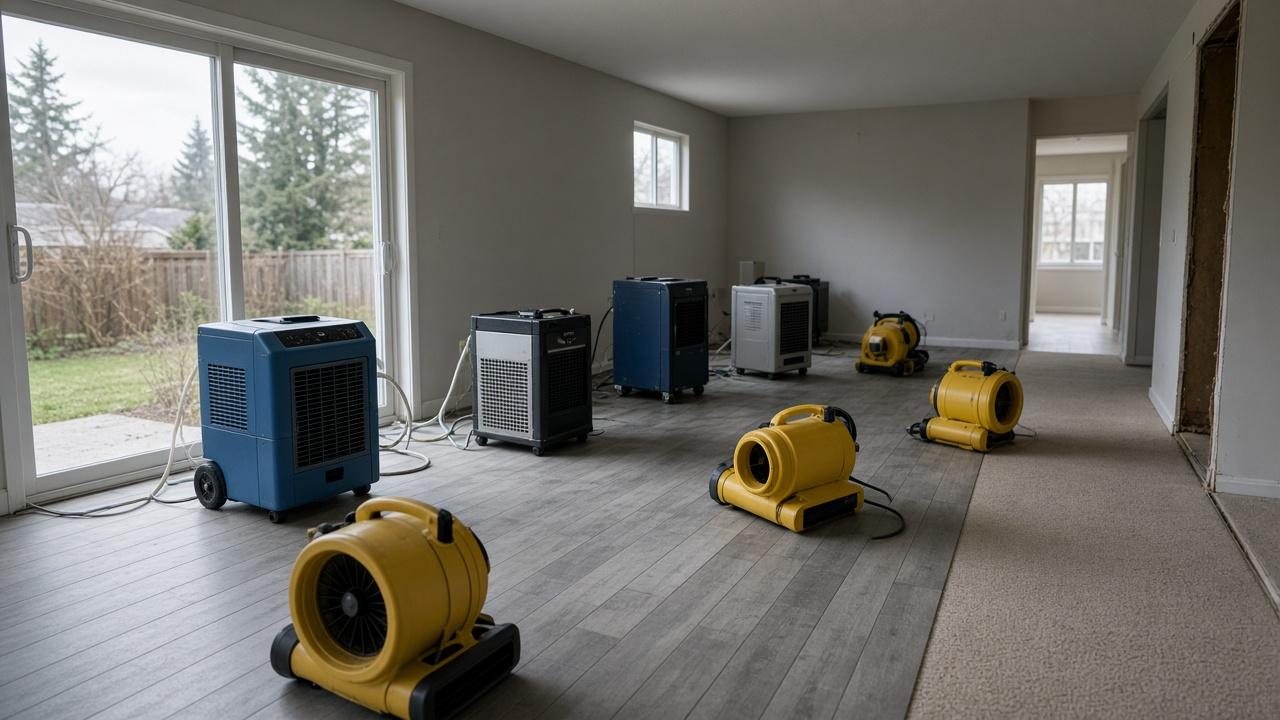
Commercial-Grade Structural Drying in Surrey, BC
LGR dehumidifiers and air movers dry walls, subfloors, and framing to safe moisture levels.
Structural drying is what separates a complete water damage recovery from a job that looks finished but isn't. Extracting visible water is the first step — but water absorbed into wall framing, subfloor assemblies, ceiling joists, and drywall can't be extracted. It has to be dried out using calibrated commercial equipment and a scientifically managed drying process.
In Surrey's wet climate, incomplete structural drying is the primary cause of delayed mold growth and long-term structural damage after a water event. Our IICRC-certified technicians follow the S500 Standard for Professional Water Damage Restoration — which means daily moisture monitoring, psychrometric calculations, and documented clearance before any equipment comes out.
What Structural Drying Actually Involves
The goal of structural drying is to return all building materials to their target moisture content — the level at which mold cannot grow and the material won't warp, rot, or degrade. For most common building materials in BC, that means wall framing below 15% moisture content, drywall below 1% above the ambient reference level, and concrete and masonry within 2-4% of a dry reference reading.
We use LGR (Low Grain Refrigerant) dehumidifiers to remove moisture from the air and from building materials via evaporation. High-velocity air movers are positioned to maximize airflow through affected areas, including inside wall cavities through small access holes where necessary. The combination of dehumidification and airflow accelerates drying by creating ideal conditions for evaporation.
We take moisture readings every day — across all affected walls, floors, ceilings, and framing members. Readings go into a drying log that becomes part of your insurance documentation. Equipment isn't removed until every single reading is within acceptable range.
Why Consumer Fans and Dehumidifiers Aren't Enough
Consumer-grade equipment is built for household applications — managing ambient humidity in a normally dry space. It's not built to handle the moisture load created by an active flood or pipe burst.
A household dehumidifier might pull a few pints of water per day under normal conditions. A commercial LGR unit can pull 80 to 200 pints per day under flood conditions. The difference matters enormously when you're trying to dry a 1,500 square foot basement in three days rather than three weeks.
Beyond capacity, the physics of structural drying require the right combination of airflow and dehumidification to work properly. Without sufficient airflow across wet surfaces, the evaporation rate drops regardless of how powerful your dehumidifier is. Our technicians calculate the correct equipment layout for each space based on the cubic footage, the type and extent of wet materials, and the ambient conditions at the time.
Structural Drying in BC's Wet Climate
The Lower Mainland's consistently high relative humidity — typically 70-85% outdoors during fall and winter — makes structural drying harder than in drier climates. High outdoor humidity means less driving force for evaporation, and it means that running equipment in a space with open windows or doors effectively negates the work the dehumidifier is doing.
Our crews work in closed and controlled environments. We seal the affected area, run equipment continuously, and monitor both the indoor conditions and the structural moisture levels. If ambient humidity spikes during drying, we adjust equipment accordingly.
This attention to climate conditions is part of why hiring IICRC-trained technicians matters in Surrey specifically. The S500 standard requires technicians to understand psychrometrics — the relationship between air temperature, humidity, and drying capacity. That's not knowledge most general contractors or handymen have.
Why Choose Us
- IICRC certified technicians
- Commercial-grade equipment
- Insurance documentation
- Available 24/7
- Licensed & insured in BC
Related Services
Wet walls, wet floors, or a moisture problem you can't solve? Call our structural drying team.
604-337-5423FAQ
Common Questions About Structural Drying & Dehumidification
Most residential structural drying projects in Surrey complete in three to five days with properly sized commercial equipment running continuously. Larger spaces, deeply embedded moisture, or dense materials like engineered hardwood or concrete can extend the timeline to seven or more days. We monitor daily and don't pull equipment until readings confirm complete drying.
We provide structural drying & dehumidification in Surrey, BC and throughout Metro Vancouver including:
Need Structural Drying & Dehumidification in Surrey?
Call us any time — our team responds fast across Surrey and Metro Vancouver.